 Website Audit & Growth Plan — prepared for Helen Mountain Cabins
Website Audit & Growth Plan — prepared for Helen Mountain Cabins
Website Audit & Growth Plan — prepared for Helen Mountain Cabins

We audited all 67 published URLs on helenmountaincabins.com — the pages, the blog, the booking page, the sitemap, robots.txt, page structure, schema and how the site renders on a phone. This is what we found.
Some of the fundamentals are genuinely good. The site loads fast, the structured data is thorough, the reviews are real — 4.95 stars from 120+ guests — and you already have a working direct-booking widget. The problem is what surrounds all that: the site was built for Google's crawler, and it shows. Roughly fifty-nine blog posts were mass-produced to chase keywords, and the pages that actually take a booking were left rough.
Three findings matter most. First, the blog is roughly fifty-nine posts, mostly AI-generated, filed entirely under "Uncategorized," with clusters of eight or more near-identical articles arguing the same point. That is the exact footprint Google's scaled content abuse policy was written to demote — and when a domain gets hit, it does not just lose the blog; it can pull down the cabin and booking pages that live on the same site. Second, your booking page still carries a leftover placeholder heading — Your Title Goes Here — above the FAQ, plus a misspelled widget and two different prices. Third, on your main cabin page the photos sit at the very bottom, under about two thousand words of repeated "cabin rentals in Helen GA" text.
None of this is hard to fix. It is a matter of publishing fewer, better pages and putting the cabin — photos, one clear price, and a booking button that works — first.
Your whole pitch is "book direct and skip the Airbnb fees." That is the right business — every stay booked here instead of a platform keeps roughly 10–15% in your pocket. But two things are quietly working against it. The organic traffic you rank on today sits on top of AI content that Google is actively demoting across the web, so it is a base that can drop overnight. And the visitors you already get meet a booking path with a placeholder heading, a blank green screen on the phone, and photos buried thousands of pixels down.
So the plan is simple: remove the risk first, then convert the traffic you already have. Everything that follows is pointed at those two outcomes.
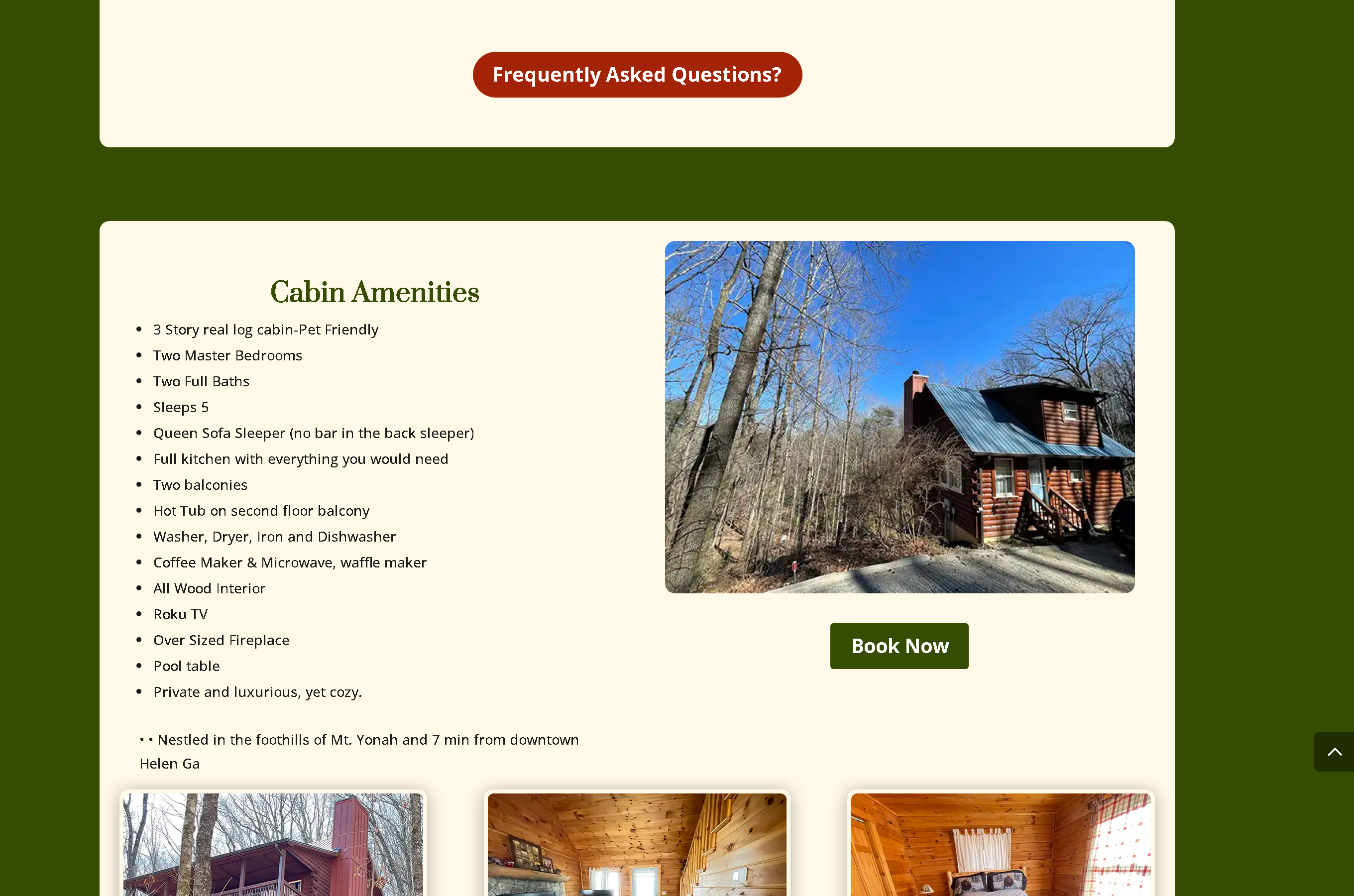
The blog holds roughly 59 posts, all filed under a single "Uncategorized" category. They read as machine-generated and they repeat themselves in tight clusters. We counted eight near-identical articles — all published between 29 May and 25 June 2026 — that make the same "book direct instead of Airbnb / VRBO" argument at about 1,500 words each:
The thumbnails are generic AI stock — hands holding phones over maps, cabins that are not yours — and at least one post (airbnb-vs-direct-cabin-booking-helen) is a broken 67-word fragment.
Why it matters: this is precisely the pattern Google's March 2024 "scaled content abuse" policy targets. A site does not have to be spam to be caught — mass-produced, near-duplicate pages are enough. When it triggers, the demotion is site-wide: the cabin page and the booking page ride on the same domain, so they fall with the blog. This is the single biggest risk on the site.
Consolidate the ~59 posts into roughly ten genuinely useful, de-duplicated guides written for guests — a real Helen area guide, a pet-friendly guide, one clear "why book direct" explainer — and redirect the rest so the equity is kept, not lost. (Plan item 02)
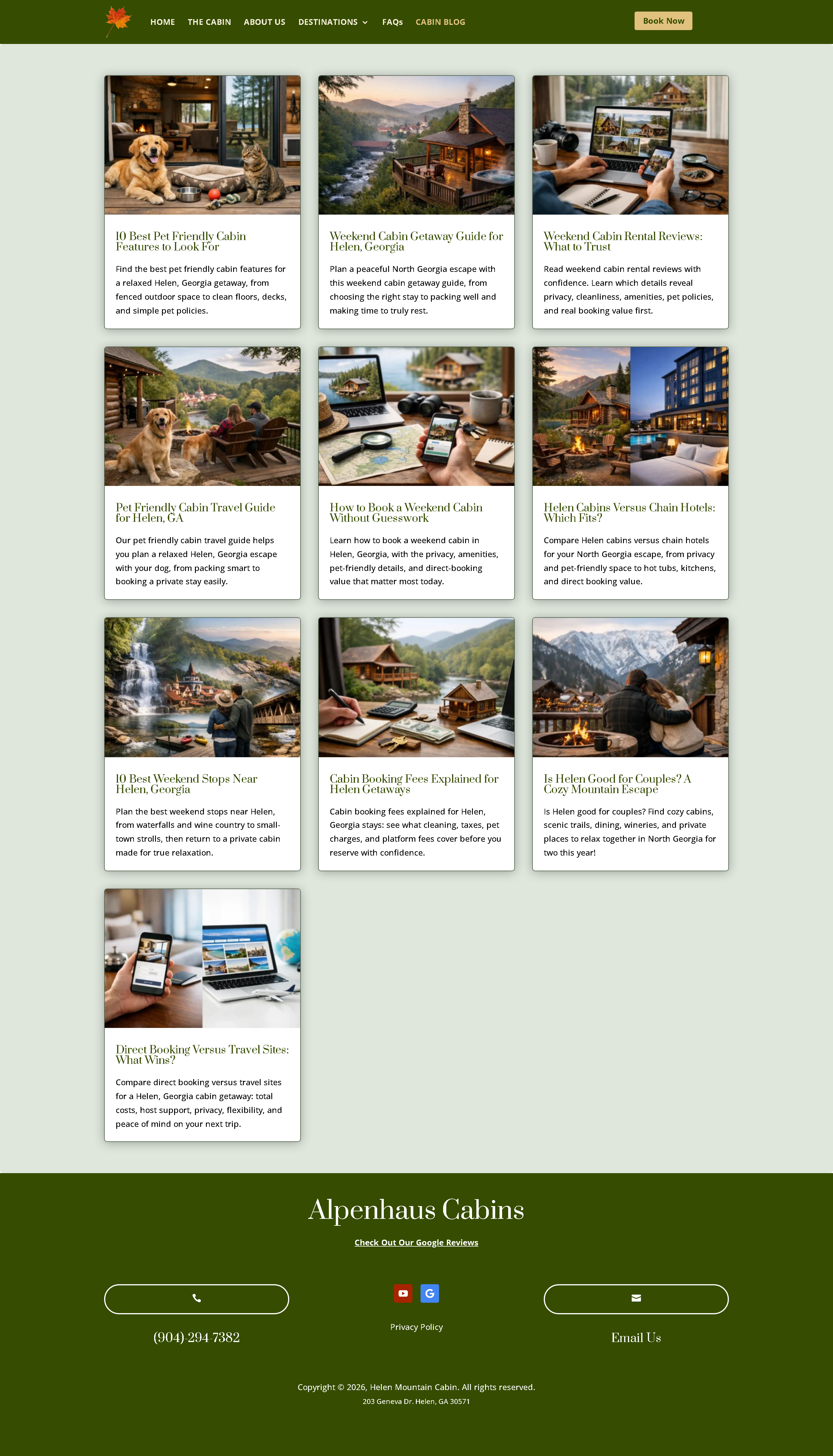
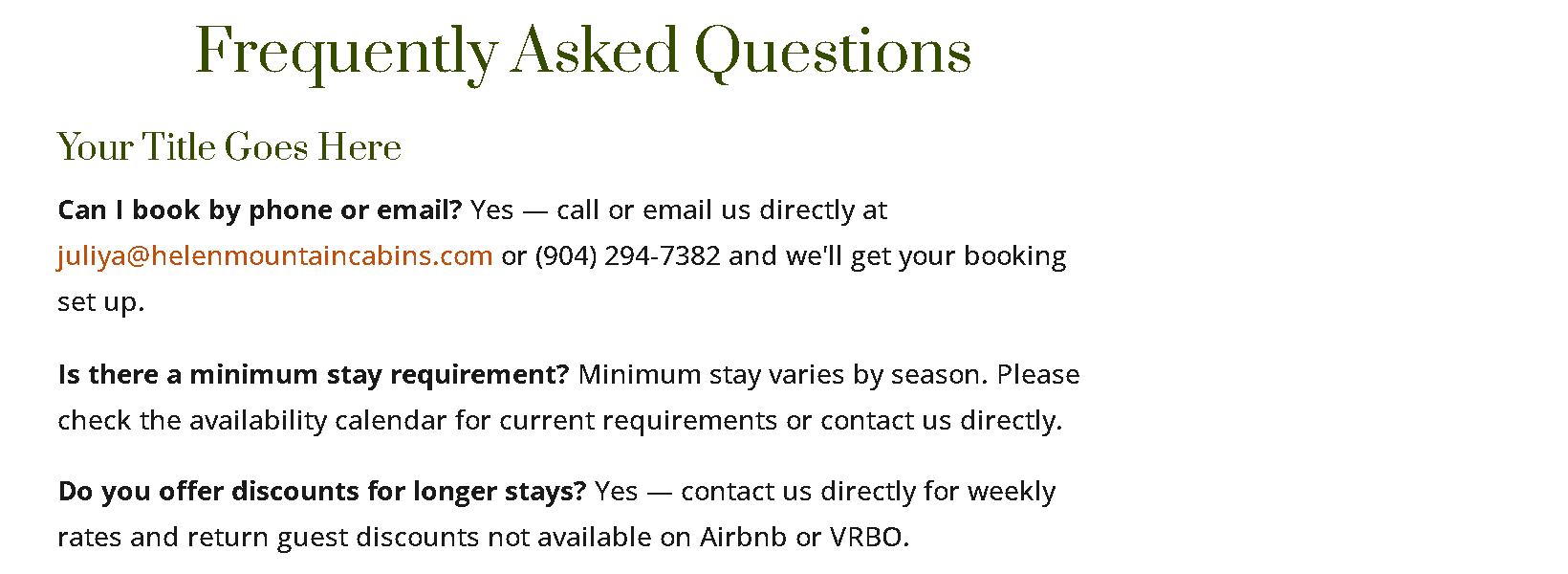
The /book-now/ page is where a guest commits — and it carries three defects a visitor sees before they trust you with a card. A leftover template placeholder, Your Title Goes Here, sits above the FAQ. The availability widget's header is misspelled CHECK AVAILIBILITY. And the widget quotes $139 a night while the rate table three lines below says "From $150."
Rebuild the booking page cleanly: remove the placeholder, correct the spelling, and drive one price from a single source so the widget and the copy can never disagree. (Plan item 05)
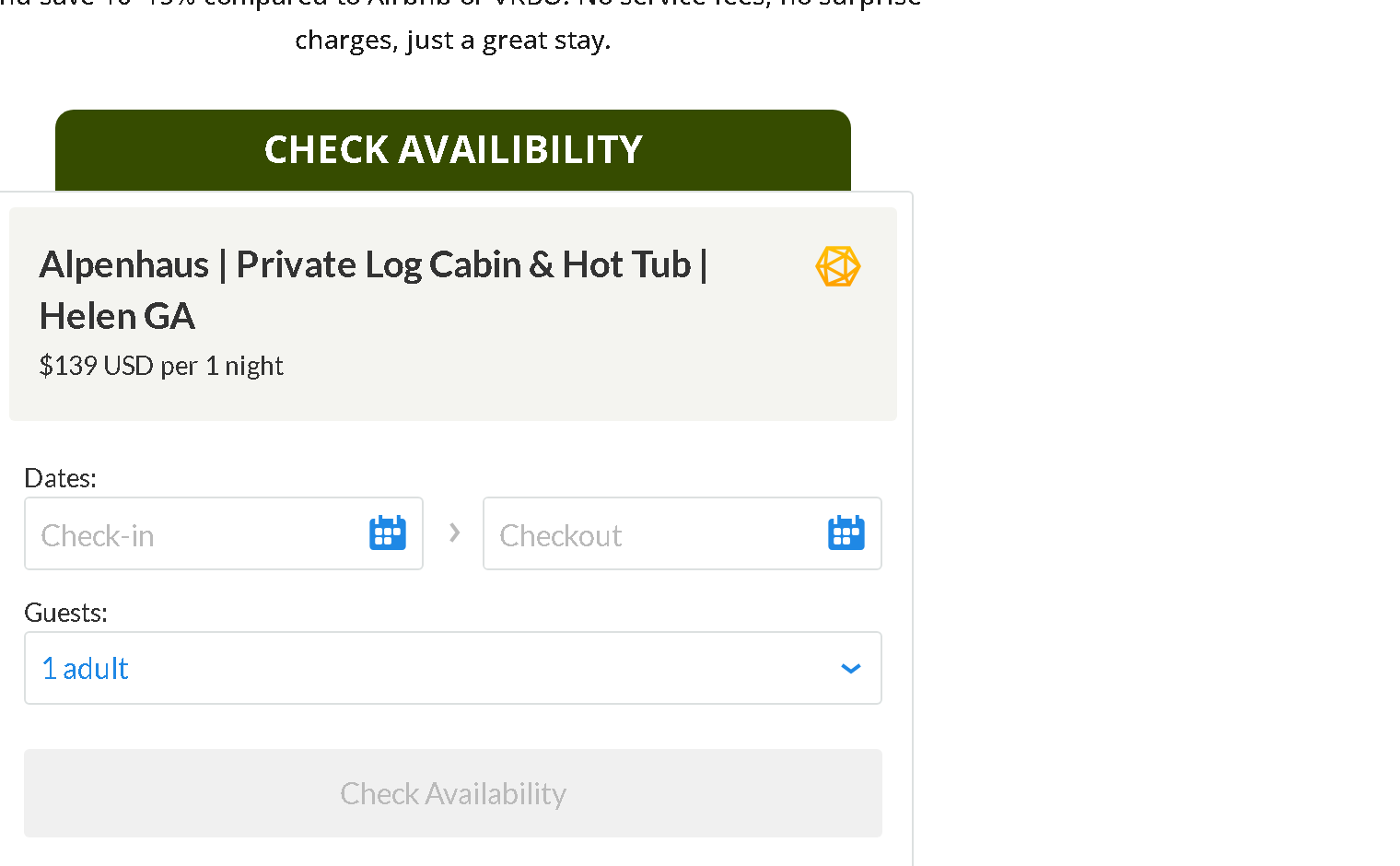
The main cabin page opens with one image, then runs about two thousand words of repetitive prose — "cabin rentals in Helen GA" appears dozens of times — across ten stacked sections. The actual photo gallery does not appear until the very bottom, roughly 13,000 pixels down. Guests choose a rental with their eyes; here they have to read an essay to reach the pictures.
Rebuild the page photos-first: a strong gallery near the top with a click-to-enlarge lightbox, amenities and price up front, and the supporting text trimmed and moved below. (Plan items 01 & 04)
Three separate pages target "pet-friendly cabins in Helen GA," and two of them are near-duplicates that aren't even in your sitemap. Google is forced to pick between them and often rewards none. The homepage, the cabin page and the North Georgia page also overlap on "Helen GA cabin rental."
Consolidate to one strong page per search intent and redirect the rest. (Plan item 03)
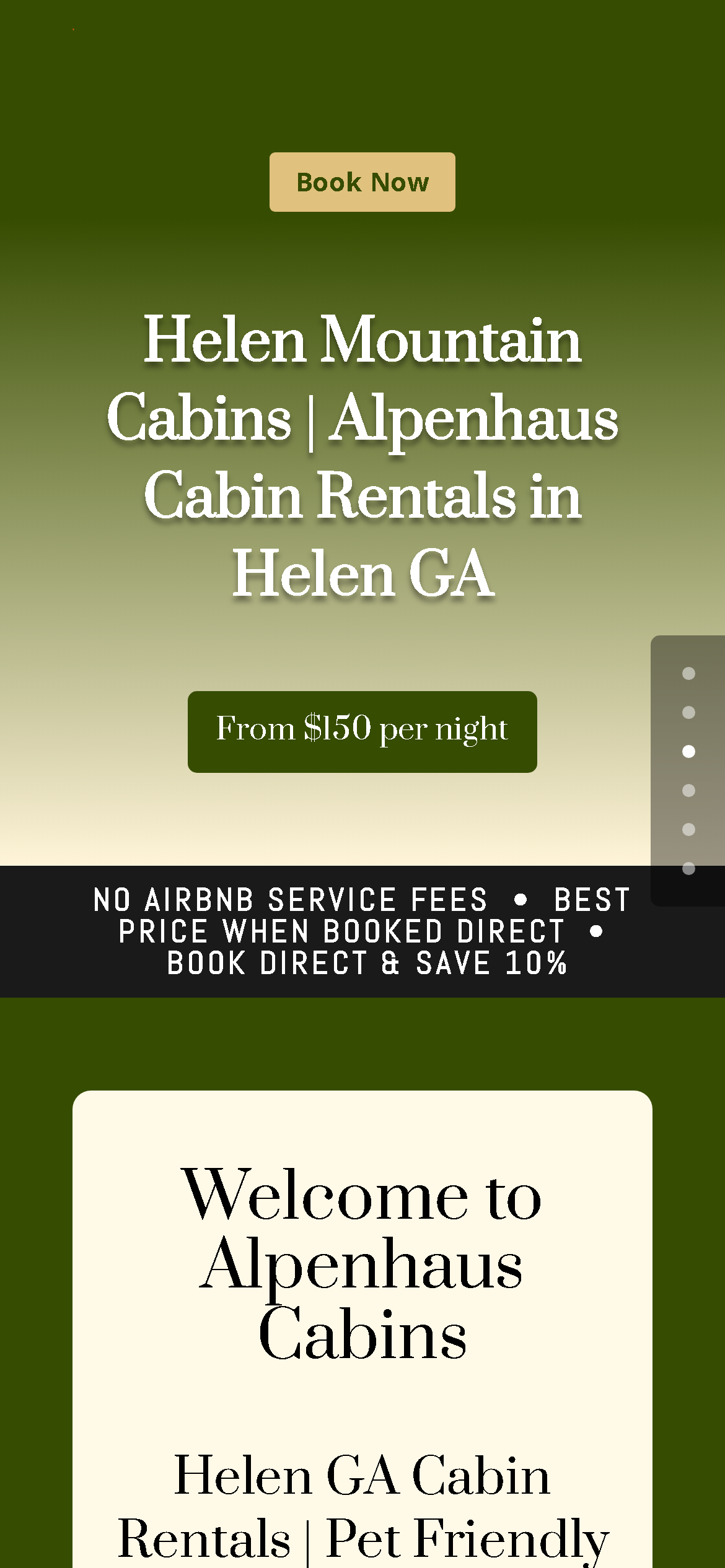
Most cabin searches happen on a phone. On a phone, your hero shows no photo at all — just a flat olive-green gradient — and an oversized four-line headline with a stray pipe character (Cabins | Alpenhaus) fills the entire first screen. A guest's first glimpse of the cabin is a blank green wall of text.
A mobile-first hero: a real photo of the cabin, a short headline, and an availability prompt visible without scrolling. (Plan item 01)
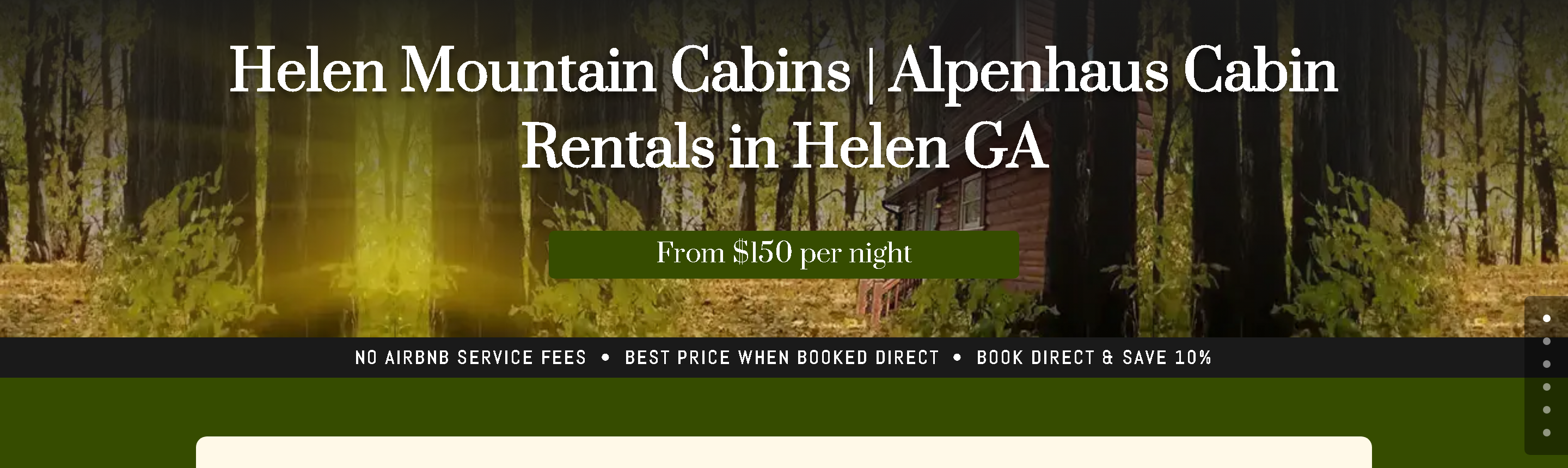
The desktop hero is a dark forest shot with visibly mirror-duplicated foliage and an unnatural neon-green cast — it reads as artificial. Property photos are served at only 600 pixels wide, so they look soft on modern and retina screens, and the blog runs on generic AI stock of cabins that are not yours. For a $150–300 night stay, the pictures are the product.
Replace the AI and mirrored imagery with your real cabin photography, served at full resolution, and art-direct a consistent gallery. (Plan item 04)
Two things quietly send bookings the wrong way. The phone link is malformed — tel:1+(904)-294-7382 — so tapping it on a phone can fail to dial. And the homepage's own social proof, "120+ verified guests," links straight to your Airbnb listing — where the same cabin costs more and one tap books it there. Your strongest proof routes buyers to the channel you're trying to beat.
Fix the click-to-call, and point the reviews link at an on-site reviews section or your Google profile — never at a booking competitor. (Plan items 05 & 07)
For a single cabin, the name shifts constantly: the header and title tag say Helen Mountain Cabins (plural), the footer copyright says Helen Mountain Cabin (singular), and the property is marketed as both Alpenhaus Cabin and Alpenhaus Cabins. Inconsistent naming weakens brand and local-search signals.
Lock one name and one property name, and apply them everywhere. (Plan item 06)
The homepage banner promises "Save 10%," the booking page says "save 10–15%," and the price appears as "From $150," "$139," and "up to $300" depending where you look. A single, consistent price and discount reads as more trustworthy — and converts better.
Set one headline price and one discount, driven from a single source across the site. (Plan item 05)
These are the headlines Google prints. Right now they are inconsistent and, in places, wrong: the FAQs title contains a stray "; its description misspells "North" as "Nort Georgia" and writes "pet policy's"; the booking-page description runs 335 characters (Google shows ~155) and begins "…Helen, GASkip the platform fees"; and the blog index has no H1 and a description that opens with an emoji.
Write clean, correctly-cased titles and descriptions for every page as part of the technical pass. (Plan item 06)
Google Analytics and the Google tag load on every page, but there is no consent banner and no cookie policy — only a privacy policy. For a US business that takes California visitors, that is a CCPA / CPRA gap worth closing.
Add a lightweight consent banner and a cookie policy, and review the privacy policy for California terms. (Plan item 08)
Each finding mapped to the plan item that resolves it. Severity reflects revenue impact, not effort.
| Severity | Finding | Business impact | Fix |
|---|---|---|---|
| Critical | ~59 near-duplicate, AI-written blog posts | Site-wide Google penalty risk | 02 |
| Critical | "Your Title Goes Here" placeholder on /book-now/ | Breaks trust at the point of sale | 05 |
| Critical | Photos buried ~13,000px down the cabin page | Guests leave before seeing the cabin | 01·04 |
| High | Three pages competing for "pet-friendly Helen GA" | Keyword cannibalization | 03 |
| High | Mobile hero shows no photo, oversized headline | Weak first impression on phones | 01 |
| High | Mirrored/AI hero, 600px photos, AI blog stock | Undercuts "luxury" positioning | 04 |
| High | Malformed tel: link + homepage link to Airbnb | Lost calls; bookings leak to OTA | 05·07 |
| Medium | Business named four ways (Cabins / Cabin / Alpenhaus) | Weak brand & local signals | 06 |
| Medium | Title/meta errors (", "Nort Georgia," 335-char) | Poor, error-laden search snippets | 06 |
| Medium | Price/offer stated three different ways | Undermines the "best price" promise | 05 |
| Medium | Analytics running with no cookie consent | CCPA / CPRA exposure | 08 |
| Medium | robots.txt references a 404 video-sitemap | Wasted crawl signal | 06 |
| Medium | Missing security headers (HSTS, Referrer-Policy) | Weaker security posture | 06 |
| Medium | Generic "No Results Found" 404 page | Dead end, no recovery path | 01 |
| Medium | 16 of 28 mobile tap targets below 32px | Harder to tap on phones | 01 |
| Medium | Imprecise, rounded map coordinates | Loose Google map placement | 07 |
One focused rebuild that removes the penalty risk, then converts the traffic you already earn. Fewer, better pages — not more of the same.
Rebuild the site photos-first and mobile-first on Cavmir's fast Cloudflare stack, keeping your direct-booking widget exactly as it works today. A real hero on every screen, the gallery near the top, a branded 404, and full backend access so you can edit it yourself. Your booking flow does not change.
The whole rebuild ships together, published within one week of kickoff. Cavmir builds with AI, so what a traditional agency quotes as a quarter of work, we deliver in days.
The one thing that stays ongoing is indexing: Google caps indexing requests at roughly ten a day, so the full set is submitted in batches over the days after launch. That is Google's limit, not ours.
Every stay you win back from Airbnb keeps roughly 10–15% in your pocket — about $25–40 a night at your rates. A handful of shifted bookings covers the social retainer; a couple of months of traffic that actually converts covers the build. And if a content penalty hit those ~59 posts, it could take your organic bookings with it — this removes that risk before it happens.